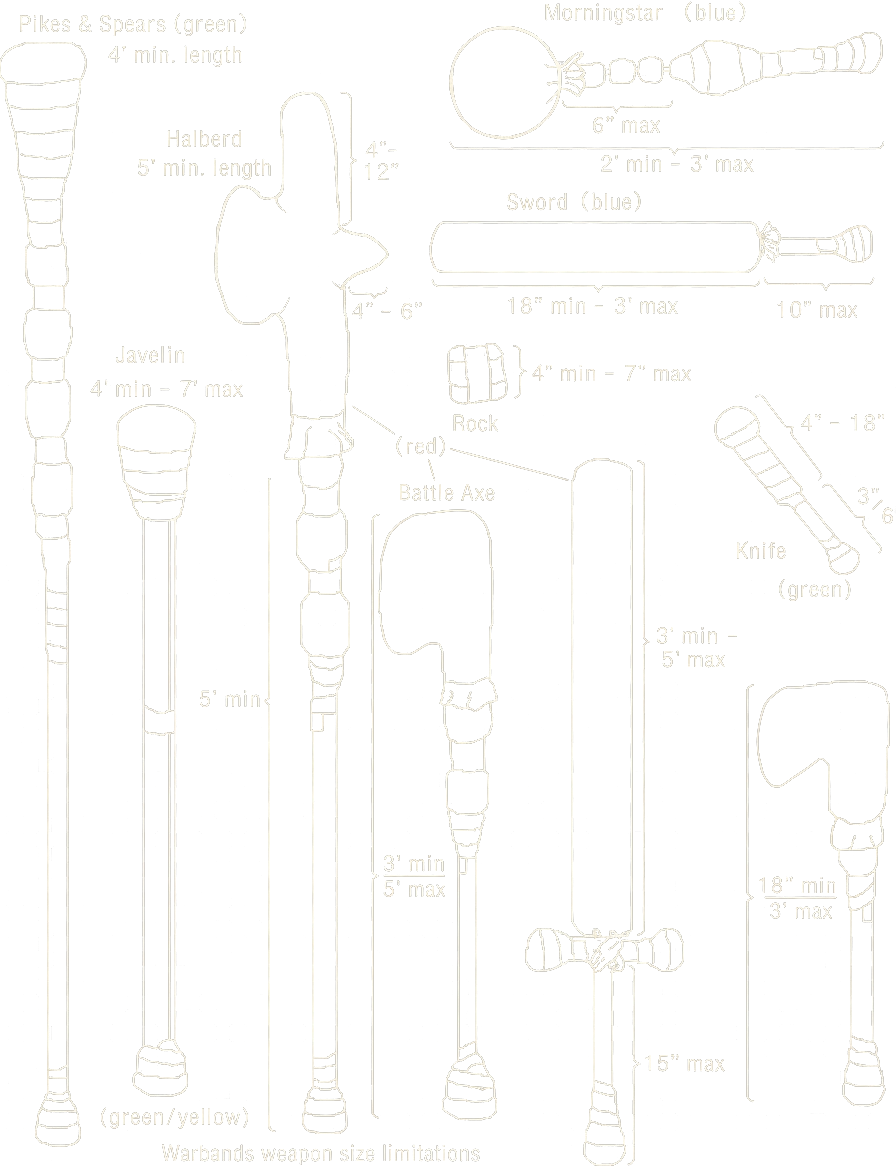
4.1.1
All weapons are subject to rejection for any safety or construction discrepancies as determined by the weapons checkers appointed by the event organizers.
4.1.2
Weapons Checkers and Marshals have the final say in determining how to classify a weapon, e.g., whether a weapon with a circular cross-section is a "sword" or a "club."
4.1.3
A safe Warbands weapon is one which when used as intended will NOT result in bruises, break bones, or knock out teeth if an unarmored person is struck with a full-strength swing.
4.1.3.1
In order to ensure Rule 4.1.3, before being allowed onto the field, all weapons are tested at full force by event appointed Weapons Checkers, unless previously failed by weapons checking staff for safety.
4.1.4
All weapons must have cloth covering over all striking surfaces.
4.1.5
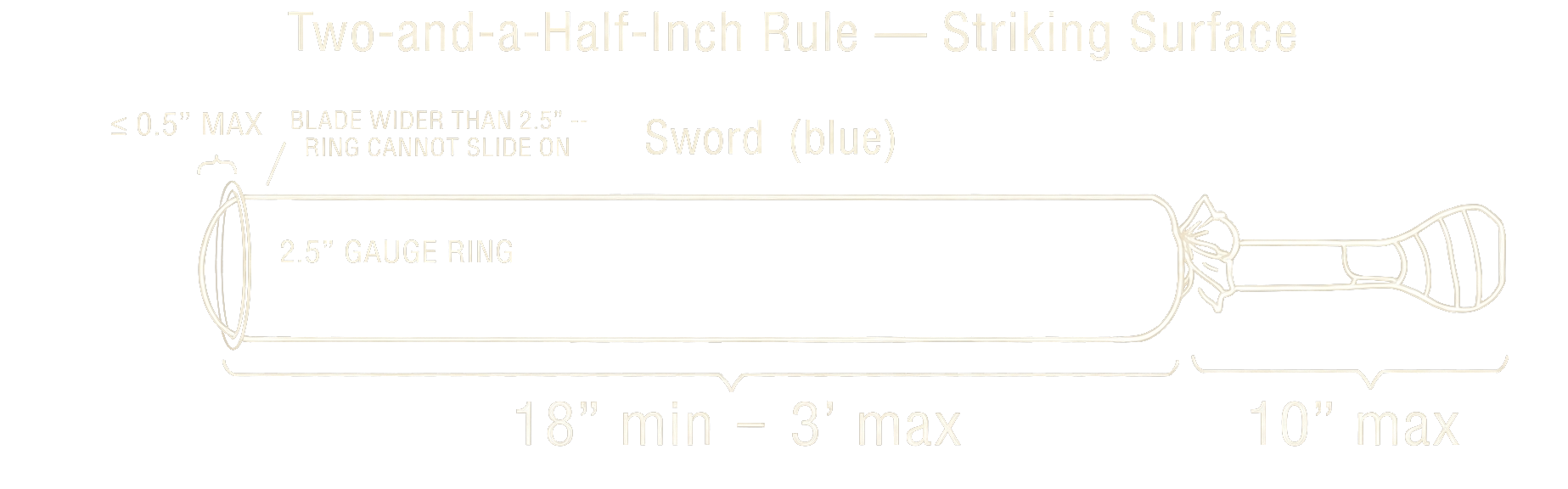
Two-and-a-half-inch rule: No part of a weapon's striking surface, whether the tip, the edge, the face or any other part, may pass easily more than 0.5" through a 2.5" diameter hole when tested in the direction of the strike.
4.1.6
Two-inch rule: No non-striking component of a weapon, such as a cross guard, a non-striking tip, or a pommel, may pass easily more than 0.5" through a 2" diameter hole when tested perpendicular to the striking surface or shaft of the weapon.
4.1.7
The flat (non-striking surface) of bladed weapons must be safely padded to prevent injury from hits from the flat of the blade.
4.1.8
Hafts on axes, flails, maces, polearms, and the like must be safely padded except for a reasonable area for a handhold. This means the haft padding on swung weapons must be as safe as their striking surface. The haft on spears (which are thrusting-only weapons) is not required to be as heavily padded as that of a swung weapon.
4.1.9
No swung weapon may have more than 1/3 of its overall length unpadded, nor have more than 30" unpadded.
4.1.10
Single-edged weapons such as glaives and cutlasses must have their non-striking edge safely padded to prevent injury from hits from the non-striking surface.
4.1.11
Restrictions:
4.1.11.1
The pommel of a weapon must be padded to prevent injury in the event of an accidental "hit" and must not easily go through a 2 inch-diameter hole.
4.1.11.2
All swung weapons must conform to the following:
4.1.11.2.1
Blue weapons of 18" or more must weigh at least 12 ounces. Under that length does not need to meet a weight or balance requirement.
4.1.11.2.2
Red weapons must weigh at least 24 ounces.
4.1.11.2.3
Balance above the un-padded handle section.
4.1.11.3
The shaft or blade of a red or blue weapon may not flex greater than 45 degrees when the weapon is swung in the plane/direction of the striking surface.
4.1.11.4
The shaft of a spear or javelin may not flex greater than 90 degrees under reasonable testing stress.
4.1.11.5
No weapons other than aluminum-shafted arrows may have metal cores.
4.1.11.6
No weapon may have a spike or blade at the butt (pommel) end. Double-ended weapons may have stabbing points at ends; this is different from a blue sword with a green stabbing spike on the pommel.
4.1.11.7
Any weapon with a wooden core must have all wood covered with tape.
4.1.11.8
Disallowed weapons include but are not limited to: Nets, lassos, pungee sticks, nunchucks, tonfas, quarter staves, double-ended daggers, punch dagger.
4.2.1
Blue weapons are edged (hacking) or mass (smashing) melee weapons intended primarily for one-handed use.
4.2.2
Blue weapons must have a minimum total length of 12 inches and a maximum total length less than 48 inches.
4.2.3
Blue weapons other than flails may have green stabbing tips or spikes.
4.2.4
Flails:
4.2.4.1
The ball of a flail must have a minimum circumference of 16 inches (measured at its narrowest point) and weigh a minimum weight of 4 oz.
4.2.4.2
The end of flail haft must follow the 2-inch rule.
4.2.4.3
The maximum "chain" length on a flail is 6 inches.
4.2.4.4
The rope or cloth of the flail "chain" must be completely covered with segmented foam (rings) to reduce the risk of injury if the chain strikes a fighter and reduce the risk of the chain wrapping a weapon or limb.
4.2.4.5
Flails are always blue weapons regardless of length.
4.3.1
Red melee weapons are long hacking and smashing weapons intended to be used primarily with two hands.
4.3.2
A swung weapon (sword, axe, mace, glaive, halberd, etc.), 48 inches or longer is considered a red weapon when swung with two hands.
4.3.3
A red weapon used with one hand counts as a blue weapon for damage.
4.3.4
Red weapons may have green stabbing tips.
4.3.5
Red weapons go through armor on the first hit when used two-handed.
4.3.6
All red weapons when used two-handed can destroy a shield with two solid blows from their legal striking surface. Blows which are mostly blocked by another weapon and light or glancing hits to a shield do not count as "shield breaking" hits. The fighter wielding the shield judges if the blows are solid "shield-breaking" red hits; however, the physical size of the fighter delivering the blows must always be considered.
4.3.7
Red weapons must weigh at least 24 ounces and balance above the top of the hand-grip.
4.4.1
Green weapons are stabbing weapons, such as spears, sword points, daggers, and stabbing points on pole arms.
4.4.2
One-hand green thrusts do not penetrate armor, including "pool-cue" style thrusts where the spear slides through one hand while being pushed with the other.
4.4.3
To penetrate armor, a green weapon must be thrust with both hands from the beginning of the thrust until it has connected solidly with the target.
4.4.4
Spears must have at least 1/3 of the haft padded, but because spears are strictly thrusting weapons, the padding does not have to be as thick as on a hacking weapon.
4.5.1
General:
4.5.1.1
Yellow weapons must be used at half-drawn (arrows) or thrown with half force (javelins) at ranges closer than 20 feet.
4.5.1.2
A yellow weapon must travel its own length through the air after it is released to count as a legal hit.
4.5.1.3
Yellow weapons do no damage if they strike shields.
4.5.1.4
Players may not ever carry another fighter's missile weapons around without the owner's express permission. You may return fire with missiles that have been shot/thrown at you, but if you leave the immediate area where the missiles were fired/thrown, you may not take any missiles other than your own with you. Players must always return the owner's missiles to the owner upon request.
4.5.1.5
Warbands-legal head/neck armor such as a helmet or coif are proof against a single missile weapon. The second hit causes death.
4.5.2
Javelins:
4.5.2.1The maximum weight of a javelin is 1.5 pounds.
4.5.2.2Javelins must be between 4 and 7 feet in length.
4.5.2.3Because they may be used as both thrown- and hand-weapons, all javelins must pass standards for both yellow and green classifications; "yellow only" javelins are not allowed.
4.5.2.4All javelins must have a yellow cover on the head (not on the pommel). No other weapons may have a yellow cover. This clearly shows which end of a javelin is safe to throw at the enemy.
4.5.2.5Javelins are exempt from the weapon flex rule and instead must not flex more than 90 degrees.
4.5.2.6Any block which stops the head of the javelin from striking its target is a legal block, including catching the javelin by the shaft or blocking it with any weapon.
4.5.2.7Javelins must be padded along their entire length.
4.5.2.8Javelins may not easily pass (<0.5") through a 3.5" diameter hole. The softer padded face must be at least 3.5" wide in all directions. The stiffer structural base foam must be at least 3" in diameter where it meets the open cell face foam.
4.5.3
Archery:
4.5.3.1All bows must have a draw weight of 35 pounds or less at 28 inches draw.
4.5.3.2Compound (pulley) bows are not allowed.
4.5.3.3Crossbows must have a maximum draw weight of 35 lbs. with a draw length of 12 inches.
4.5.3.4Arrows must always be shot; they can never be used as hand weapons.
4.5.3.5To be an archer at an event, a player must bring at least 2 passing arrows to the field.
4.5.3.6If an arrow is deflected, even minutely, it is considered to have hit. An arrow must strike with its head to cause a hit.
4.5.3.7Once an arrow has hit an object (changed its path) it is harmless. An arrow cannot strike multiple targets.
4.5.3.8To better simulate the speed and power of real arrows in flight, the only things which can stop arrows are shields or Warbands-legal head armor such as a helmet or coif. Arrows cannot be caught, blocked, deflected, or knocked out of the air by anything else, including hands, feet, weapons, or other equipment. If an arrow is blocked intentionally with anything other than a body part, shield, or head armor, the fighter doing the blocking is dead automatically.
4.5.3.9Bows may be used to turn aside thrusts without suffering any damage. However, if a bow is hacked or smashed by a red or blue weapon, the bow is considered broken. A healer may heal a bow.
4.5.3.10Archers are allowed to call shots for clarity, i.e., they may call out to let their target know where a hit landed or if the hit was "good."
4.5.3.11If an arrow strikes a limb which has already been hacked or smashed by a blue or red weapon, the arrow is considered to have continued as if the limb were not there, hitting whatever is in its path.
4.5.3.12If a weapon accidentally blocks an arrow from hitting a target, the arrow is considered to have hit the target anyway.
4.5.3.13If an arrow hits a fighter's hand, that arm is lost (regardless of whether the hand held a weapon or shield).
4.5.3.14If an arrow hits a foot which is off the ground, that leg is lost.
4.5.3.15Arrows:
4.5.3.15.1All arrow shafts over 28" in length are required to have a draw stop (generally a ring of tape around the shaft) placed between 27" and 28" down the shaft from inside of the nock.
4.5.3.15.2Arrows may not easily pass (<0.5") through a 2.5" diameter hole. The softer padded face must be at least 2.5" wide in all directions. The stiffer structural base foam must be at least 2" in diameter where it meets the open cell face foam.
4.5.3.15.3All arrows must contain a circular metal disk measuring at least 3/4 of an inch in diameter and 1/16 of an inch thick (the size of a penny) secured perpendicularly at the end of the shaft, unless it is an arrow with a golf tube shaft (in which case a washer or disk slightly larger than the golf tube's rolled edge must be used instead). All circular disks must be at least the hardness of a penny.
4.5.3.15.4All arrow striking surfaces must be constructed of open-cell foam.
4.5.3.15.5All arrows must have at least two full vanes/fletchings (feathers) and a nock.
4.5.3.15.6Masking-like, unenforced cellophane, rigid, metal based, hard, sharp, or poor adhesion quality tapes may not be used in construction. Examples include but are not limited to: ducting, packaging, scotch, masking, and painter's tapes. (Note: duct tape is allowed, as ducting tape is a separate type.)
4.5.3.15.7Wooden arrows are not permitted.
4.5.3.15.8There can be no tape on the striking surface of an arrow.
4.5.3.15.9The head of the arrow must not be able to move easily in relation to the arrow shaft. This movement includes but is not limited to: twisting without return, twisting more than a quarter of the shaft circumference with return, plunging up and down, wobbling from side to side.
4.5.3.15.10In order to avoid confusing golf tube arrows with javelins, no arrow using a golf tube shaft may have a yellow cover.
4.6.1Rocks must be at least 4" in diameter and constructed of foam with as little tape as possible, and all aspects of their construction must conform to the 2½ inch rule.
4.6.2The maximum weight of a rock is 1.5 pounds.
4.6.3Rocks must be thrown; a fighter may never strike another fighter with a hand-held rock.
4.7.1Shields must be safely padded on the front and all edges. Any dangerous protrusions (bolts, handles, etc.) on the rear must be taped and/or padded for the user's safety.
4.7.2A shield may be used or worn in any manner, and it will still remain a shield; e.g., a shield may be carried on the arm, held in one or two hands, worn on the back, or propped against a fighter's side.
4.7.3A fighter may wear or carry only one shield at a time in combat.
4.7.4A shield may not be taller than the distance between the wielder's chin and their ankles, nor wider than 3 feet.
4.7.5The minimum diameter of a shield is 12 inches.
4.7.6Shields may be virtually any shape but must have handles and/or arm-straps. If a shield is made to strap onto the body and has no means to carry it on the fighter's arm, it is not allowed.
4.7.7All red weapons when used two-handed can destroy a shield with two solid blows from their legal striking surface. The fighter wielding the shield judges if the blows are solid "shield-breaking" red hits.
4.7.8When a shield is destroyed by two red-weapon hits, the wielder of the shield must immediately drop the shield. Additional hits from any type of weapon that strike before the shield is dropped count as though the shield isn't there (generally counting first against the shield-wielder's arm, then their torso).
4.7.9Anvilling, laying a weapon on a shield to avoid taking damage, is not permitted. A weapon must intercept the red weapon before it strikes the shield. If the red weapon continues past the attempted block with significant force, the blow still counts as a red weapon hit.
4.7.10Fighters may use a red weapon while also using a shield.
4.7.11Shield "spikes" are for ornamentation only and do no damage.
4.7.12Shield Kicking: Players are allowed to kick shields with the bottom of the foot (as opposed to the toe), provided the kicker keeps one foot on the ground. (No flying kicks!) Shield kicking must be done with regard for the safety of other fighters and will be monitored carefully by the Marshals.
4.7.13Shields may be covered in non-latex based soft plastic sealant (e.g. Plasti-dip) as an alternative to cloth as long as they pass all other requirements.
4.7.14No shields may have metal cores.
4.7.15A shield must exhibit sufficient rigidity to prevent it from significantly deforming when struck with a solid blow from a padded weapon.
4.8.1A shield bash means using a shield to strike an opponent starting from a distance more than two steps away.
4.8.2A shield check means using a shield to strike an opponent starting from a distance two steps away or closer.
4.8.3Players may shield bash an opponent on their front or side. Bashing an opponent from the rear is prohibited. Bashing a kneeling opponent is prohibited.
4.8.4Players may shield check an opponent from any direction. Players may shield check opponents who have lost a leg.
4.8.5It is never permissible to strike a fighter in the head or neck with a shield.
4.9.1Grappling is defined as wrestling in a safe and reasonable manner, attempting to subdue or unbalance your opponent without strikes, throws, or joint/nerve holds.
4.9.2A person in armor or rigid plastic safety equipment or carrying a bow and/or arrows may never initiate a grapple.
4.9.3Players are not allowed to initiate a grapple starting more than two steps away from an opponent.
4.9.4Grappling from behind should be done with great caution and will be closely monitored by Marshals for safety.
4.9.5Body checks (blocking your opponent's movement using one's body) are allowed.
4.9.6Punching and kicking are never allowed, except in the case of shield kicks as outlined above.
4.9.7An unarmored fighter may choose to initiate a grapple with any opponent, including those who are armored or carrying bows or arrows.
4.10.1Whenever you strike an opponent from behind, simultaneously call out the color of your weapon ("Red!" "One-Handed Green!") so that your opponent will know how to react. If a weapon color is not called out, expect that your opponent will treat it as a hit from a blue weapon, the most common weapon encountered on the battlefield.
4.10.2Strikes ignore sheathed weapons (i.e., one that is attached/hanging from one's belt or over one's back) or any other worn object, including baggy clothing such as cloaks. If an attack would have made legal contact with a fighter had the object been absent, then it should be counted as a hit. A weapon must be in a fighter's hand to intercept an attack.
4.10.3Anvilling, the act of laying one's weapon on a shield or body part to avoid taking damage, is not permitted.
5.1.1All types of armor provide the same level of protection.
5.1.1.1Armor is subject to the same restrictions as garb with regards to resemblance to modern clothing and incorporation of modern symbols. Armor does not waive the garb requirement for the wearer unless all modern clothing is completely covered by the armor.
5.1.1.2Only items specifically constructed as armor and recognizable as armor shall be counted as armor. Armor shall be counted as such only when worn as intended. No item with an obvious function other than armor, such as straps, quivers, pouches, boots, scabbards, bandoleers, etc., shall be considered to be armor regardless of the material of its construction.
5.1.2Armor protects only the area it covers, e.g., one hit from a blue weapon to an unarmored elbow results in the loss of that arm, even if the rest of the arm is armored.
5.1.2.1Hits to areas that are both armored and unarmored must be taken to the unarmored area. Gaps in armor coverage of ¾" or less shall be ignored.
5.1.3Armor may not be concealed and must remain visible to other fighters. Players may wear a surcoat or tabard over armor so long as the armor is easily visible.
5.1.3.1Items of garb that appear to be armor, at the discretion of either the events' armor checker or garb checker, or any Marshal, may not be worn on the field.
5.1.4The front, back, and sides of any part of the body are considered a single strike zone for armor coverage. Think of armor protection in Warbands this way: armor lessens the damage from some types of hits but does not eliminate damage entirely.
5.1.5No one wearing armor or rigid safety gear may initiate grappling.
5.2.1Armor is not required for protection, but instead to enhance game play. Therefore, any construction and materials are permitted with the following caveats:
5.2.1.1Armor must look like armor from a distance of 5'. Therefore, materials such as spray-painted cloth, garment-weight leather, and obvious plastic or rubber are not permitted.
5.2.1.2Armor must not crack, crumple, remain deformed, pull apart, or otherwise sustain actual damage from a legal hit with a padded weapon, or contact with the ground.
5.2.1.3When struck with a legal weapon, armor must not damage that weapon.
5.2.1.4Rigid armor including helmets must have no spikes or points and must have blunted edges.
5.2.2Armor must not be able to catch any appendages such as fingers.
5.2.3Metal hand armor is forbidden.
5.2.4Metal knee or elbow armor with wings or discs are forbidden.
5.2.5Metal arms and knees must not have projecting hard edges when the limb is bent.
5.2.6
Helmets may have a non-period bar grill.
5.2.6.1Bar grills must not crack, crumple, remain deformed, pull apart, or otherwise sustain actual damage from a legal hit with a padded weapon, or contact with the ground.
5.2.6.2Bar grills are not considered armor and do NOT block missile weapons.
6.1When in doubt of any of these rules, ask a Marshal.
6.2When killed, fall to a prone position on the ground or kneel as you put a weapon over your head.
6.2.1Res battles deaths must put weapons over your head and walk safely to the res point.
6.3When you lose an arm, drop anything that is in that hand and put the arm behind your back. Do not switch equipment from the lost arm to your non-injured arm (this so-called "magic switch" is specifically prohibited). Do not use your "lost" arm to aid in shield checking, shield bashing, or grappling.
6.3.1If the arm was hacked or smashed with a blue or red weapon, any other strike to the same arm counts as a torso hit, because in the Warbands combat rules the arm would not be there to intercept the hit.
6.4If you lose a leg, you must drag that leg, limping along. This prevents you from running, jumping, etc.
6.5Two hits from a red or blue weapon to a leg results in death.
6.6If you have two limbs hacked or smashed by red and/or blue weapons, the result is death. Stab wounds from green and yellow weapons do not count towards this rule, even if they are inflicted by the green stabbing point of a red or blue weapon.
6.7If asked, a fighter must accurately describe their current armor damage and wound status. Players may never fake death or wounds during a battle to mislead opponents.
6.8At no time may the dead speak to the living, unless it is to shout a safety warning that is "outside" of Warbands combat, e.g., "Look out, you're about to step off a cliff!"
6.9.1The Healer cannot heal their own wounds or equipment.
6.9.2To heal a person, the Healer must be in direct physical contact with the injured person.
6.9.3A healer may not heal a person while either are under direct attack. If the Healer or injured person is attacked or distracted, or contact is broken for any reason, the entire Poem of Healing must be read or recited again.
6.9.4A Poem of Healing must then be recited or read aloud. The minimum length of a poem of healing is 180 syllables.
6.9.5When the healer completes reading the Healing Poem, all wounds and any items held by the wounded fighter are healed or repaired (i.e., armor, bow, shield, etc.).